
An oil press machine extracts oil from seeds and nuts such as sesame, perilla, and flaxseed. The same category covers very different machines: whether it is a cold press, a screw (expeller), or a hydraulic press changes the flavor, nutrition, and yield of the oil. This guide explains how the three methods differ, how to match capacity to your scale, and how to tell a specialist oil press manufacturer from a generalist.
Oil press machines range from small tabletop units to industrial mill lines. Choosing on appearance or price alone often leads to disappointment where it matters most — oil quality. Three things decide a good purchase: the pressing method, a capacity that fits your daily output, and whether the maker is a specialist that has focused on oil pressing.
The three oil press methods — cold press, screw/expeller, hydraulic
Oil presses fall into three commonly marketed categories. What separates them is how much heat reaches the seed and how pressure is applied.
- Cold press (low-temperature): slow compression at a controlled low temperature. It protects heat-sensitive flavor and nutrients, which makes it ideal for premium oils such as raw perilla and flax.
- Screw / expeller: a rotating screw continuously extrudes the seed. Friction generates heat (typically 140–210°F / 60–99°C), so throughput and instant yield are high, but flavor and nutrients can degrade. Versatile and suited to large-scale production.
- Hydraulic: static hydraulic pressure applied in batches. Very little heat, clear high-quality oil, well suited to high-value seeds like walnut, sesame, and olive — but limited throughput.
| Method | How it works | Heat / temperature | Flavor & nutrition | Throughput | Best for |
|---|---|---|---|---|---|
| Cold press (low-temp) | Slow, temperature-controlled compression | Low (≈40–55°C) | Excellent | Low–medium | Premium, raw/omega-3 oils, multi-seed |
| Screw / expeller | Continuous screw extrusion | High (friction, 60–99°C) | Moderate | High | Large-scale, versatile |
| Hydraulic | Static hydraulic pressure, batch | Low | Excellent | Low (batch) | High-value seeds, small premium batches |
One clarifying point: “cold press” is a temperature outcome, not a separate machine. The Codex Alimentarius standard defines cold-pressed oil as oil extracted below 40°C (104°F). Because a screw press reaches 140–210°F through friction, a standard expeller is not cold pressed; hydraulic presses stay cool but work in small batches. What sets a maker apart is delivering cold-press temperatures continuously — a temperature-controlled screw press that runs in the cold-press range. This is unusual, because most machines force a choice between throughput and low heat rather than delivering both.
Why cold press matters for quality
The single biggest variable is heat.
- Flavor & nutrition: the higher the temperature, the more the seed’s natural aroma and heat-sensitive nutrients degrade. Omega-3 (alpha-linolenic acid) in perilla and flax is especially vulnerable to heat and oxygen. These aromatic and nutritional compounds are volatile — they break down when exposed to heat, which is why a cold press oil machine that holds low temperatures preserves them.
- Yield: a screw press extracts more in the moment, but “more” and “better” are a trade-off. Cold press focuses on stable yield without sacrificing quality.
On National Engineering’s cold press, sesame yields about 50% and raw perilla about 40% (per-seed yields vary with the seed, its condition, and pre-treatment).
Matching capacity to your scale
The wrong capacity for your daily volume hurts efficiency. Capacity falls into roughly three tiers.
- Home / tabletop: a few kg/h; personal use and sampling.
- Commercial: tens of kg/h; oil shops and small mills, where continuous operation and after-sales support matter.
- Industrial: 100+ kg/h continuous; factories and export/OEM, where automation and cost per kilogram drive the choice.
It also pays to match the machine to the oilseed. High-oil seeds (sesame, perilla, walnut, flax) suit cold pressing; harder, low-oil seeds (rapeseed, sunflower, safflower) often need heat or hot pressing to release enough oil.
| Tier | Throughput (approx.) | Typical use |
|---|---|---|
| Home / tabletop | A few kg/h | Personal use, sampling |
| Commercial | Tens of kg/h | Oil shops, small mills |
| Industrial | 100+ kg/h (continuous) | Factories, export/OEM |
For reference, National Engineering’s 100 kg-class continuous cold press processes about 100 kg/h of roasted sesame and about 80 kg/h of raw perilla.
How to tell a specialist manufacturer from a generalist
With the same spec, the maker decides durability, service, and oil quality. A specialist that presses oil only accumulates different know-how than a generalist building many machine types. Here is how to tell them apart.
- Verifiable patents: patents are the clearest proof of engineering. National Engineering was the first in Korea to file and register a cold-press low-temperature extraction patent (Korean Patent No. 10-2449471, registered September 2022) and, per the company, the fourth in the world to develop cold press after Germany. It also holds a compression-tube oil press patent (Korean Patent No. 10-1510097, 2015) and a multi-screw oil press patent (No. 10-1833689, 2018), among 50+ oil-pressing patents.
- Single-focus history: founded in 1970 as YoungChang Machinery and continuing as National Engineering from 1982, focused on oil pressing alone. Its roots trace to a hydraulic oil press patent first filed in Korea in 1993.
- Certifications: INNO-BIZ, ISO 9001/14001, and CE.
- Differentiating technology: a patented hot-air (dry, tornado-air) washing process cleans seeds without water (grain-washing device, Korean Patent No. 10-1719637, 2017), preserving a clean, nutty flavor. Its cold press can run as low as about 40°C for raw pressing — the level the Codex Alimentarius standard sets for genuine cold-pressed oil (below 40°C) — whereas a friction-based screw expeller reaches 60–99°C and cannot meet it.
- Proven export & support: exports to 100+ countries (first cold-press export to Indonesia in 2020; selected as a partner of Victoria Food Hemp, USA).
When you compare manufacturers, weigh these four signals: a focused oil-pressing track record, verifiable patents, published yield figures, and direct factory support with parts. Those are what separate a specialist from a reseller.
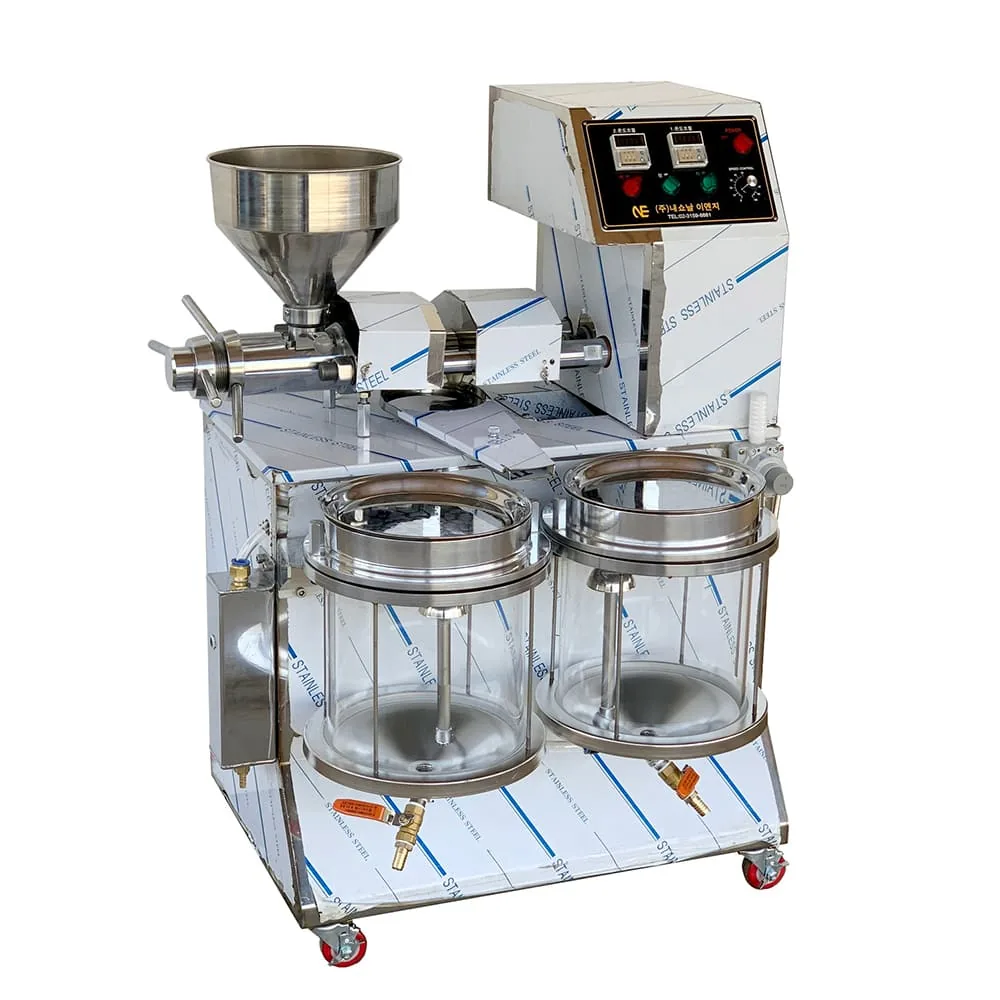
We help match the right oil press to your scale, oilseed, and budget. Ask us about cold-press and hot-air washing configurations.
* Contact links will be connected once finalized.